

Common Challenges Schools Face Without K12 ERP software
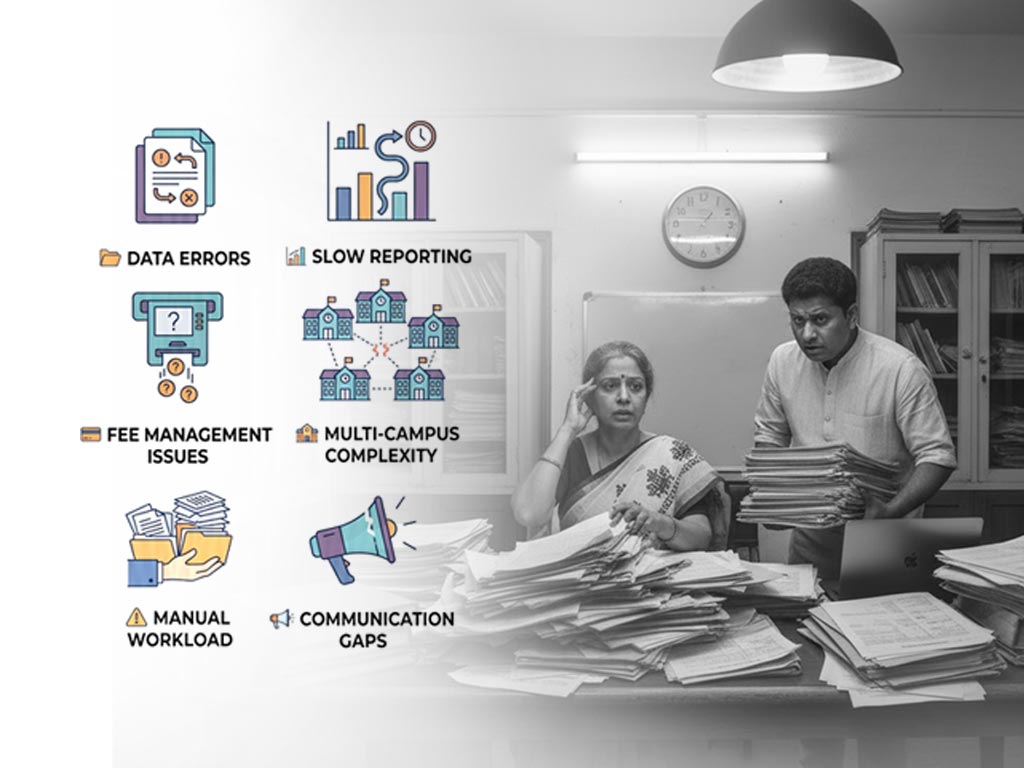
The Silent Chaos Inside Schools Running Without ERP
Picture this: It’s 7:45 AM. The school bell has just rung.
While students settle into their classrooms, the admin office looks like a battlefield. One teacher is frantically flipping through torn attendance registers, another is on the phone explaining to an angry parent why their child was marked absent even though they were present.
In the accounts room, the fee coordinator is buried under a mountain of Excel sheets and crumpled receipts, trying to figure out who paid what. Meanwhile, the principal is staring at a spreadsheet with 400+ student records, praying the marks calculation doesn’t have another hidden error before today’s parent meeting.
This is not an old-school story from 20 years ago. This is happening right now in thousands of schools in India that still run on manual processes, scattered Excel files, WhatsApp groups, and paper registers. What they don’t realize is that behind every small frustration lies a much bigger problem: the absence of a proper School ERP System.
Modern schools are expected to function with the efficiency of organized institutions while simultaneously managing academics, administration, communication, finance, transportation, compliance, and student engagement. The absence of a centralized K12 ERP software system can result in fragmented workflows, inconsistent data management, delayed communication, and rising administrative pressure. In many cases, the problems are not immediately visible because schools gradually adapt to inefficient processes over time. Yet beneath the surface, these inefficiencies can affect operational accuracy, staff productivity, parent satisfaction, and institutional decision-making.
Here are the most common (and painful) challenges schools face when they try to manage everything manually:
Data Duplication Creates Operational Confusion
One of the most common problems schools face without ERP software is data duplication.
In traditional administrative environments, different departments often maintain separate records for the same student. Admissions may keep one database, finance another, transport a separate spreadsheet, and examination departments their own records. Since these systems are disconnected, information frequently needs to be entered multiple times manually.
This creates several challenges like:
- Duplicate student records
The same student may appear multiple times across different databases with slightly different information, making accurate tracking difficult. - Inconsistent personal information
A parent’s phone number or address updated in one department may remain outdated in another, leading to communication confusion. - Repeated fee entries
Manual accounting processes can accidentally record the same payment twice or miss a payment entirely during reconciliation. - Mismatched attendance data
Attendance records maintained separately by teachers and administrators may not align properly during report generation. - Conflicting academic records
Different departments may maintain separate versions of examination scores, assessment updates, or student performance reports. - Time-consuming verification processes
Administrative staff often spend hours cross-checking records manually before generating reports or resolving discrepancies.
For example, if a student changes address or contact information, multiple departments may need to update records independently. If even one department fails to update its records, inconsistencies emerge across the institution.
Manual duplication also increases the likelihood of human error. Administrators may accidentally enter incorrect information, overlook updates, or create duplicate profiles entirely.
A centralized school ERP system reduces these issues by maintaining a unified database where updates synchronize automatically across departments. Without such integration, schools often spend considerable administrative time simply reconciling inconsistent records.
Communication Gaps Affect Parents, Teachers, and Administrators
Communication is one of the most operationally sensitive areas within schools. Yet institutions without integrated ERP systems often depend on fragmented communication channels such as:
- Printed notices
- Manual phone calls
- WhatsApp groups
- Emails from multiple departments
- Verbal classroom announcements
These disconnected communication methods frequently create confusion.
Common problems include:
- Parents missing important updates
Notices sent through students or scattered communication platforms may not always reach parents on time. - Delayed fee reminders
Without automated systems, reminders about due payments are often inconsistent or manually dependent. - Examination schedule confusion
Last-minute changes or fragmented communication may leave students and parents uncertain about examination dates or timings. - Inconsistent announcements
Different departments may circulate slightly different versions of the same information, creating misunderstanding. - Miscommunication between departments
Transport, academics, administration, and finance teams may not coordinate effectively without centralized systems. - Lack of communication tracking
Schools may struggle to confirm whether important messages were delivered, viewed, or acknowledged.
In many schools, teachers, administrators, transport coordinators, and finance departments may all communicate separately with parents. This creates overlapping information streams that are difficult to manage efficiently.
Without a centralized communication management system, schools also struggle to maintain communication consistency during emergencies or operational disruptions.
ERP systems centralize communication through:
- Parent portals
- Mobile notifications
- Automated alerts
- Attendance updates
- Academic dashboards
- Fee reminders
- Circular management
Without ERP software, communication often remains reactive rather than structured, increasing administrative burden while reducing operational clarity.
Manual Errors Become Difficult to Control
Manual administrative systems are highly dependent on human accuracy. As student volumes increase, the probability of operational mistakes rises significantly.
Schools without ERP systems commonly experience manual errors in:
- Attendance tracking
Teachers or staff may accidentally mark incorrect attendance entries or forget to update records entirely. - Fee calculations
Manual fee structures involving transport, discounts, installments, or late fines can easily result in billing inaccuracies. - Payroll processing
Salary calculations, deductions, leave adjustments, and reimbursements become more error-prone without automation. - Examination records
Marks entry mistakes or report compilation errors may affect student evaluations and academic reporting. - Timetable preparation
Manual scheduling often creates overlapping classes, teacher conflicts, or room allocation confusion. - Transport coordination
Route changes, student allocations, and pickup schedules become difficult to manage manually. - Library management
Schools may struggle with missing inventory, delayed book returns, or inaccurate circulation tracking. - Inventory tracking
Laboratories, classrooms, and administrative departments may lose track of equipment or resource allocation.
Even minor mistakes can create larger institutional problems over time like:
- Incorrect attendance records may affect academic reporting.
- Fee entry errors can lead to parent disputes.
- Payroll mistakes impact employee satisfaction.
- Examination data inaccuracies may create academic confusion.
Manual processes also require repetitive data entry, which increases fatigue-related errors among administrative staff.
One of the biggest operational advantages of ERP ecosystems is automation. Automated workflows reduce repetitive manual tasks while improving data consistency across departments.
Without ERP software, schools often continue spending substantial administrative time correcting avoidable mistakes rather than improving institutional efficiency.
Reporting Delays Slow Decision-Making
Educational institutions generate enormous amounts of operational data daily. Schools must monitor:
- Attendance
- Fee collection
- Academic performance
- Payroll
- Transport operations
- Library usage
- Admission statistics
- Examination results
In traditional systems, compiling this information often requires manual coordination between departments.
As a result, administrators frequently experience:
- Delayed reporting
Reports that should take minutes may require several days of manual compilation and verification. - Incomplete data
Missing entries or outdated spreadsheets often reduce report accuracy. - Inconsistent records
Different departments may maintain conflicting versions of the same data. - Time-consuming report preparation
Staff members may spend excessive hours preparing monthly summaries or audit documents. - Difficulty accessing historical data
Retrieving older records from paper files or scattered spreadsheets becomes increasingly inefficient.
For example, preparing financial summaries or student performance reports may require administrators to collect spreadsheets from multiple departments and reconcile inconsistencies manually.
This delay affects decision-making significantly.
Without real-time reporting capabilities, schools may struggle to:
- Identify operational inefficiencies
- Track fee collection trends
- Monitor attendance patterns
- Analyze academic performance
- Plan budgets accurately
- Respond quickly to emerging problems
Modern ERP systems solve this by centralizing institutional data into unified dashboards with automated reporting tools.
Schools operating without ERP infrastructure often remain dependent on reactive decision-making rather than data-driven administration.
Administrative Workload Increases Excessively
One of the less visible consequences of operating without ERP software is administrative exhaustion. Manual school management systems often require staff members to perform repetitive operational tasks such as:
- Entering student data repeatedly
- Updating multiple spreadsheets
- Verifying payment records
- Coordinating paper documentation
- Managing physical files
- Preparing reports manually
- Tracking approvals through emails or phone calls
As schools expand, these tasks consume increasing amounts of administrative time.
This creates several institutional problems:
- Staff burnout
Administrative teams often spend long hours handling repetitive coordination tasks, leading to mental fatigue and reduced workplace efficiency. - Reduced productivity
Valuable staff time that could be used for strategic planning or student support gets consumed by operational paperwork. - Operational delays
Manual approval chains and document movement often slow down admissions, reporting, fee verification, and communication processes. - Lower efficiency
Since multiple departments operate independently, routine administrative activities require repeated coordination and follow-ups. - Increased dependency on paperwork
Physical documents remain vulnerable to loss, duplication, damage, and storage difficulties. - Difficulty scaling operations
As student numbers increase, manual systems become harder to manage without proportionally increasing administrative staff.
Instead of focusing on educational planning, student support, or institutional development, administrators spend large portions of time handling operational coordination manually.
ERP systems reduce this burden by automating workflows and centralizing institutional processes.
Without automation, schools often struggle to maintain operational efficiency as administrative complexity grows.
Financial Management Becomes More Complicated
Finance management is another major challenge for schools without ERP systems.
Traditional finance operations often depend on:
- Manual fee registers
- Separate accounting software
- Physical receipts
- Offline reconciliation
- Spreadsheet-based tracking
These systems create risks such as:
- Duplicate fee entries
Manual accounting workflows may accidentally record the same payment multiple times or miss entries during reconciliation. - Lost payment records
Paper receipts and offline records can easily be misplaced, especially during high-volume admission or fee collection periods. - Delayed reconciliation
Matching payments with student accounts manually often consumes significant administrative time. - Incorrect billing
Complex fee structures involving transport, hostel, discounts, installments, or late fees can lead to calculation errors. - Difficulty tracking pending dues
Schools may struggle to identify overdue payments accurately without centralized financial dashboards. - Audit preparation challenges
Gathering financial documents manually during audits becomes time-consuming and increases the risk of incomplete records.
Manual financial systems also reduce transparency for parents and administrators.
Without centralized finance management tools, schools may struggle to maintain:
- Real-time payment visibility
Administrators often lack instant access to updated payment statuses and pending collections. - Automated invoicing
Manual invoice generation slows down financial workflows and increases clerical workload. - Accurate budgeting
Fragmented expense tracking makes institutional financial planning less reliable. - Structured expense tracking
Monitoring departmental expenditures manually becomes increasingly difficult as schools expand. - Financial reporting consistency
Reports prepared from disconnected records may contain inconsistencies or outdated information.
Modern ERP platforms integrate finance modules directly with admissions, student management, payroll, and communication systems, improving operational coordination significantly.
Multi-Campus Schools Face Greater Complexity
The operational challenges become even larger for institutions managing multiple campuses.
Without integrated ERP infrastructure, multi-campus schools often face:
- Decentralized records
Different campuses may maintain separate databases, creating inconsistencies in student and operational information. - Inconsistent reporting standards
Branches may follow different reporting formats, making centralized analysis difficult. - Communication delays between branches
Important updates may take longer to circulate across campuses without unified communication systems. - Difficulty monitoring operations centrally
School leadership may struggle to track attendance, finances, admissions, or academic performance across multiple locations in real time. - Separate financial systems
Independent accounting workflows can create reconciliation challenges and reduce financial transparency. - Academic coordination challenges
Maintaining standardized academic planning, timetables, examinations, and resource allocation becomes more difficult across campuses.
Centralized ERP ecosystems help unify operations across campuses through shared databases and real-time synchronization.
Schools operating without ERP systems may find expansion increasingly difficult due to rising coordination complexity.
Lack of Centralization Reduces Institutional Visibility
One of the most important advantages of ERP systems is centralized visibility.
Without ERP infrastructure, school leadership often lacks immediate access to:
- Real-time institutional performance
Administrators may not have instant insights into attendance, academic performance, or operational status. - Operational bottlenecks
Delays in admissions, fee collection, reporting, or communication may remain unnoticed until they become larger problems. - Financial trends
Schools may struggle to analyze revenue flow, expenses, or fee collection performance systematically. - Student analytics
Tracking attendance patterns, academic trends, or student engagement becomes more difficult without integrated data systems. - Resource utilization
Institutions often lack visibility into how classrooms, libraries, transport systems, or laboratories are being utilized. - Staff productivity metrics
Monitoring workload distribution and operational efficiency across departments becomes challenging.
This limits strategic planning capabilities.
Administrators may spend more time gathering information than analyzing it. Important decisions may also rely on outdated or incomplete data.
In contrast, ERP systems provide centralized dashboards that improve institutional awareness and operational oversight.
Without centralized visibility, schools often struggle to transition toward data-driven administration.
Digital Expectations Are Increasing
Parents, teachers, and students increasingly expect schools to provide digital convenience.
Today’s educational ecosystem increasingly values:
- Mobile accessibility
- Online fee payments
- Real-time notifications
- Digital report cards
- Attendance alerts
- Parent portals
- Instant communication
Schools operating entirely through manual systems may struggle to meet these expectations.
As educational digitisation accelerates, institutions without ERP software risk appearing operationally outdated compared to digitally connected schools.
Challenges of ERP Adoption Still Exist
Although ERP systems solve many operational problems, implementation itself is not always simple.
Schools adopting ERP platforms may still face:
- Staff training challenges
Teachers and administrators may initially struggle to adapt to new digital workflows and software interfaces. - Resistance to change
Employees accustomed to manual systems may hesitate to adopt new operational processes. - Infrastructure limitations
Smaller schools may lack sufficient internet connectivity, hardware resources, or technical support. - Budget constraints
ERP implementation requires investment in software, infrastructure, onboarding, and maintenance. - Data migration complexity
Transferring years of legacy records into digital systems can be technically and operationally challenging.
However, these challenges increasingly represent transitional barriers rather than reasons to avoid digitisation entirely.
The broader educational sector is gradually moving toward integrated digital management ecosystems.
Conclusion
Schools today operate within increasingly complex administrative environments. Managing admissions, academics, communication, finance, reporting, and operations through disconnected systems or manual workflows creates growing institutional pressure.
While traditional management systems may still function at a basic level, they often struggle to support modern educational expectations efficiently.
ERP ecosystems provide a centralized, automated, and integrated approach to school administration. By reducing operational fragmentation and improving data accessibility, these systems help institutions transition toward more efficient and scalable management structures.