

Protecting Student Privacy: How Multi-Tier Permission Trees Stop Internal Data Leaks | K12 technology solutions
For modern Indian schools and multi-campus universities, managing student data is no longer just about digital record-keeping. Today, your central database holds everything from personal identifiers and academic grades to financial ledgers, health data, and behavioral logs.
With the strict enforcement of the Digital Personal Data Protection (DPDP) Act now in full swing, safeguarding this information isn’t just an operational preference—it is a critical legal mandate which are maintained by K12 technology solutions. While external hackers grab the headlines, a massive chunk of data vulnerabilities actually comes from within: excessive user access privileges.
To stop internal data leaks, institutions must abandon flat access models and switch to structured, multi-tier user permission trees.
The Danger of Flat Access: The Silent Culprit of Internal Leaks
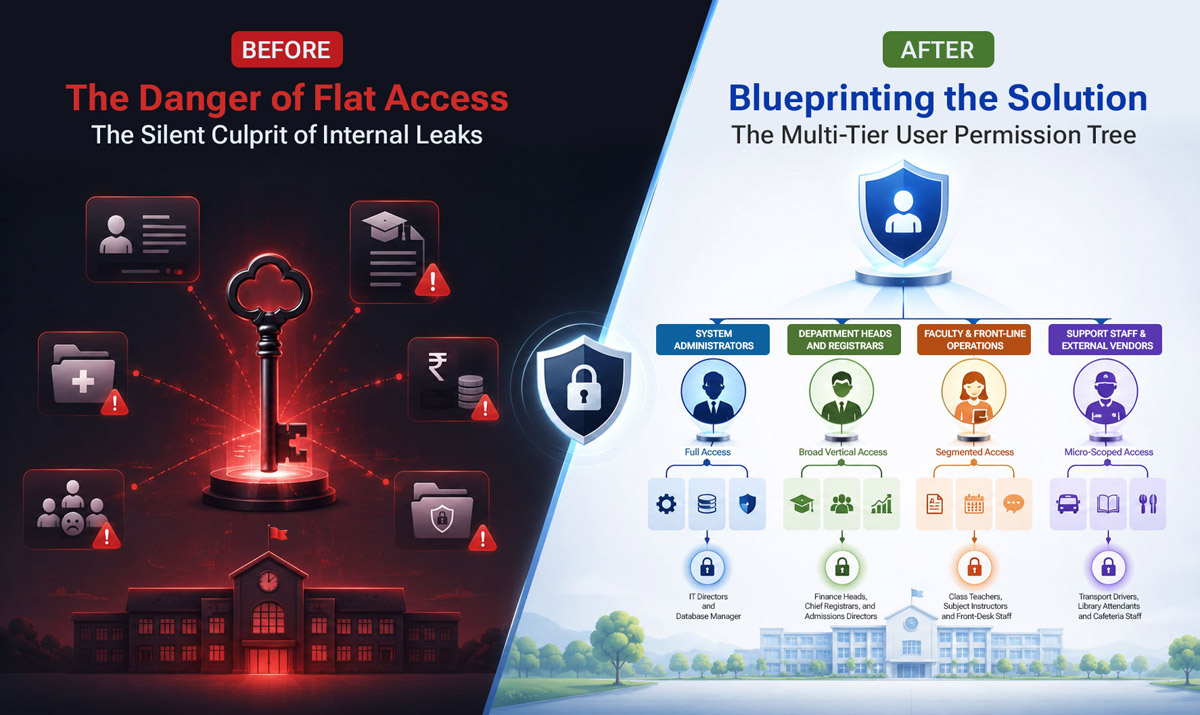
In legacy K12 technology software, access controls are dangerously broad. A single “Staff” or “Teacher” login might accidentally let a user view the entire school’s health records, outstanding fees, or employee payroll.
When one account has sprawling access across multiple departments, the risk of data exposure skyrockets. This usually triggers three main issues:
- Departmental Overrides: Unauthorized or accidental edits to financial records or student grades.
- Accidental Exposure: A teacher downloading a full Excel sheet of school data when they only needed to check one student’s attendance.
- The Domino Effect: If a single staff member’s login credentials get phished, the entire school’s central database is instantly exposed to malicious actors.
Blueprinting the Solution: The Multi-Tier User Permission Tree
The ultimate antidote to flat access is the Principle of Least Privilege (PoLP). Staff members should only access the precise data points required to perform their daily duties.
To achieve this, educational institutions must map out a multi-tier permission tree based on roles and clearance levels:
Tier 1: System Administrators (Full Access)
- Who they are: IT Directors and Database Managers.
- What they do: They hold the master keys to configure system settings, manage global infrastructure, and issue user roles. However, to maintain absolute safety, even Tier 1 accounts should be restricted from altering student grade databases or financial logs without documented approvals.
Tier 2: Department Heads & Registrars (Broad Vertical Access)
- Who they are: Finance Heads, Chief Registrars, and Admissions Directors.
- What they do: They possess complete read-and-write permissions exclusively within their operational vertical. A Finance Head can process fee balances and generate ledgers but cannot view private student health files or modify academic grading curves.
Tier 3: Faculty & Front-Line Operations (Segmented Access)
- Who they are: Class Teachers, Subject Instructors, and Front-Desk Staff.
- What they do: Access is dynamically restricted by active assignments. A grade-10 math teacher can input math marks for their specific section but remains blocked from viewing or editing grades for other sections or accessing parents’ bank details.
Tier 4: Support Staff & External Vendors (Micro-Scoped Access)
- Who they are: Transport Drivers, Library Attendants, and Cafeteria Staff.
- What they do: They can view only the exact operational field required for their immediate tasks—such as a student’s name and bus route—without seeing any academic performance details or home addresses.
Building Blocks of a Leak-Proof System
Structuring a permission tree is only half the battle. To guarantee bulletproof student data privacy, your school ERP platform must actively enforce three security layers:
- Granular Read/Write/Export Barriers
- Read: Allows users to view information relevant to their current task.
- Write: Restricts editing privileges (e.g., preventing a class teacher from modifying past outstanding fee balances or locked final exam grades).
- Export: The highest-risk action. Downloading data into CSV or Excel sheets must be strictly restricted to certified data officers to prevent bulk internal leaks.
- Multi-Factor Authentication (MFA) at Critical Intersects
- Verifying identity is crucial. Enforcing mandatory Multi-Factor Authentication (MFA)—especially for Tier 1 and Tier 2 accounts—creates a vital shield against phished or compromised credentials.
- Comprehensive, Immutable Audit Trails
- Every action must leave a digital footprint. If an employee alters a student profile, updates an admission entry, or opens a sensitive file, the platform must instantly log the timestamp, IP address, and user ID. Real-time monitoring and unalterable logs deter bad actors and quickly pinpoint the source of any accidental exposure.
Conclusion: Cultivating Digital Trust in Education
As educational ecosystems transform into fully connected digital hubs, managing data access is the foundation of institutional integrity. By structuring clear, multi-tier user permission trees, schools can effortlessly protect student privacy, eliminate severe DPDP compliance penalties, and slash internal administrative overhead. Securing student data is a continuous commitment to privacy, operational efficiency, and community trust.