

School Management System vs Traditional Administration: Which is Better for Your Institution?
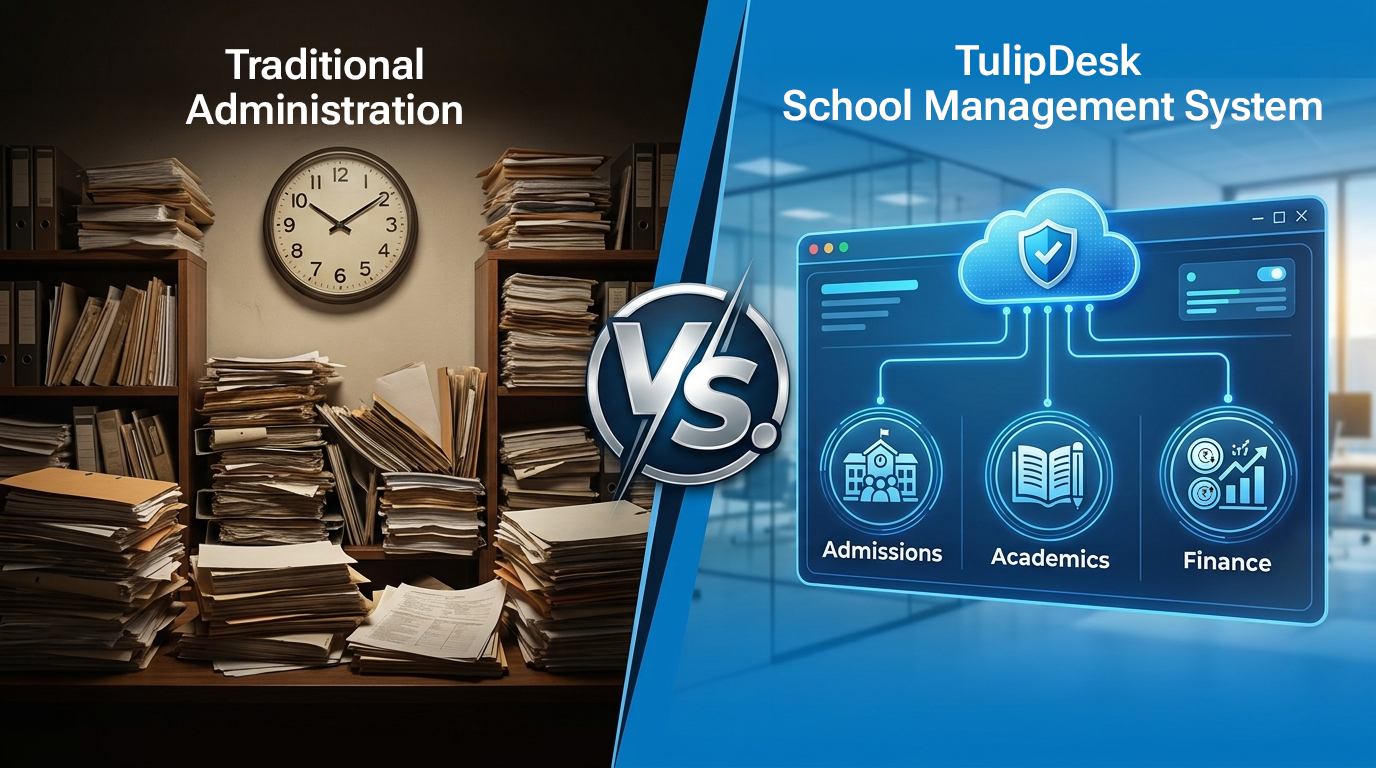
For modern Indian K12 schools and multi-campus educational groups, running an institution smoothly is becoming increasingly complex. From regulating online admission management to organizing complex financial ledgers and generating real-time academic progress reports, daily operations carry a massive administrative footprint.
Yet, thousands of traditional institutions still manage these massive workflows over un-synchronized registers, isolated spreadsheets, and physical paperwork. While legacy frameworks feel familiar, they introduce hidden risks: massive administrative overhead, human errors, revenue overrides, and compliance vulnerabilities. To build a future-ready educational ecosystem, leaders must face a critical choice: persist with traditional, manual administration or transition to a centralized, cloud-based [school management system]. Let’s break down how these two approaches stack up against each other.
The Friction of Traditional Administration: A Drain on Productivity
Traditional school administration relies heavily on fragmented, decentralized workflows. In this model, every department operates as an isolated silo. The front-desk collection counter handles receipts by hand, the main accounting office manually updates fees & finance management ledgers, and teachers spend hours cross-checking physical attendance sheets.
This manual friction triggers several systemic operational bottlenecks:
- The Reconciliation Lag: When student data or payments must travel across physical registers and disconnected Excel sheets, compiling a single report takes days. This lag results in severe “operational leakage” and financial discrepancy.
- Wasted Hours on Routine Tasks: Administrators and educators lose hours every single week to repetitive paperwork—such as cross-checking payroll logs or manually calculating library fines. This drains institutional productivity and pulls teachers away from classroom teaching.
- Internal Security & Compliance Risks: Traditional systems struggle to partition sensitive data. Broad or unmonitored access means employee payroll logs, financial records, and student medical histories are often vulnerable to unauthorized internal viewing or accidental bulk spreadsheet downloads.
The Cloud ERP Advantage: Streamlined Operations and Real-Time Control
A modern, cloud-based School ERP completely flips the script by integrating every department into a single, unified database. Instead of moving paper across rooms, institutions experience instant automated cloud data synchronization across admissions, transport, payroll, and financials.
Switching to a robust digital ecosystem provides an institutional upgrade across key core pillars:
- Eradicating Financial Discrepancies
In traditional systems, minor “revenue leakage” occurs when billing structures are altered manually. A smart ERP enforces strict technical mechanisms, locking fee schedules and enabling automated posting directly to ledgers. Front-counter transactions instantly update the central database, providing absolute financial oversight with zero manual intervention.
- Drastic Reductions in Administrative Overhead
By shifting routine data collection to automated workflows—such as digital registrations via an [online admission management] module or instant parent alerts for transport updates—schools cut down immense operational friction. On average, forward-thinking institutions achieve an exceptional decrease in administrative overhead, freeing up staff to focus on student outcomes.
- Enterprise-Grade Security and Compliance Readiness
With India’s strict Digital Personal Data Protection (DPDP) Act in full swing, safeguarding student privacy is a critical legal mandate. Unlike traditional open spreadsheet models, modern cloud systems allow institutions to build a structured user permission architecture. By defining role-based access controls, classroom teachers only see their designated section rosters, while high-risk actions like bulk spreadsheet downloads remain tightly restricted.
Conclusion: Cultivating Digital Trust and Efficiency
Choosing between a School Management System and traditional administration is no longer just an operational preference; it is the ultimate foundation of institutional integrity, efficiency, and compliance. While manual methods keep your school tied down to administrative delays and data risks, a centralized cloud platform unlocks seamless workflows, absolute financial clarity, and data-driven milestones. Investing in enterprise-grade school software is the definitive way to build community trust and future-proof your educational group.
Transform Your Institution with TulipDesk
Built on a secure cloud platform with advanced encryption, role-based access controls, and full DPDP Act readiness, TulipDesk gives your school absolute control over its data while slashing manual paperwork. Keep your school operations streamlined and protected, always.