

From Online Admission Management to Alumni: How a Complete Student Records Management System Stops Enrollment Drops
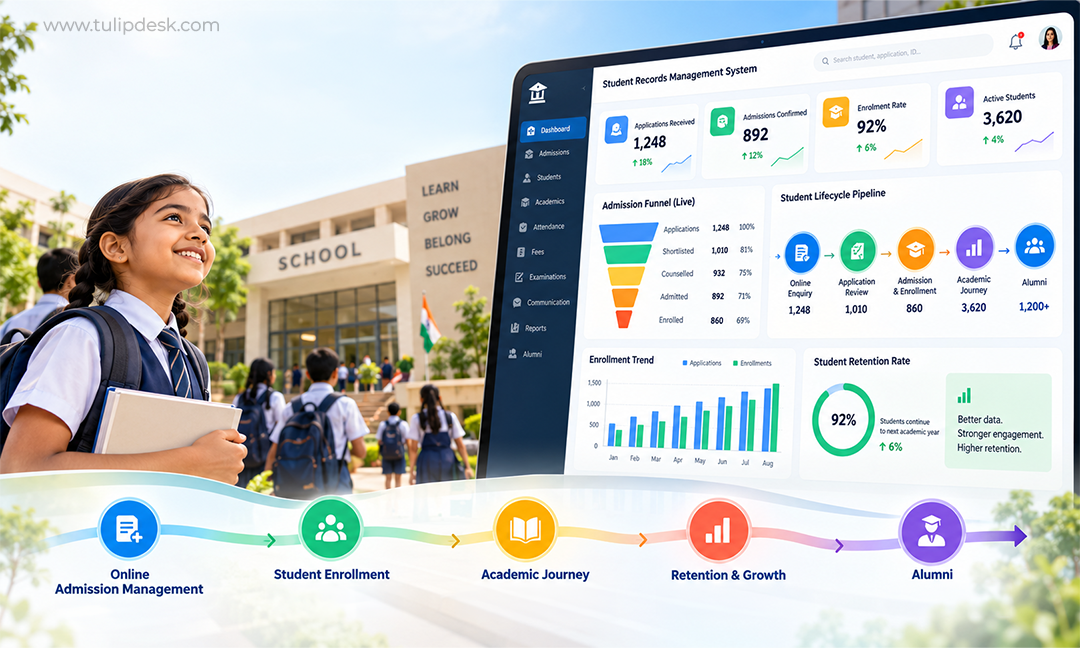
Stopping enrollment drops requires more than just a flashy intake portal of a school. A potential family will turn elsewhere if they encounter unclear documentation, inconsistent communication, and delayed application responses. To be honest, enrollment declines are rarely caused by high tuition fees or poor curricula in today’s competitive educational environment. They occur because parents are irritated by outdated administrative procedures even before their child enters a classroom. Schools need to upgrade in order to ensure institutional growth.
The first line of defense against declining student enrollment is switching from disjointed registers to an integrated online admission management process, which keeps families involved from the first click through graduation and alumni networks.
What is Online Admission Management?
The entire student intake process is automated and centralized using online admission management, a cloud-powered digital framework. Digital form distribution, applicant screening schedules, automated interview tracking, and direct fee collections with no human intervention take the role of physical paper forms, manual queue management, and isolated spreadsheets.
Why is Online Admission Management Important?
Institutional trust is determined by first impressions. Parents can tell that a school is contemporary, well-run, and committed to excellence when the admission process functions like a well-oiled digital machine. On the other hand, schools lose potential students within the first 24 hours of inquiry due to manual inefficiencies. By doing away with physical documentation, offering fast digital receipts, and initiating automated contacts that notify parents at each phase, a strong platform prevents potential student leakage.
How does Online Admission Management Work?
Through a series of automated procedures intended to reduce administrative friction, contemporary cloud systems speed up the application intake process.
Digital Inquiry & Form Distribution:
Through a secure online gateway, prospective parents fill out personalized application forms.
Automated Screening & Data Indexing:
Without the need for human data entry, applicant information is automatically added to the central database.
Dynamic Interview Scheduling:
The system automatically notifies parents via email or SMS and assigns interview times.
Instant Fee Integration:
To avoid reconciliation problems, application and admission fees are safely collected online and posted straight to institutional ledgers.
Smooth SIS Transition:
After being approved, student profiles immediately move into the main SIS ( Student Information System), creating an ongoing lifecycle record.
Benefits of Online Admission Management
For K–12 schools and multi-campus educational organizations, using a centralized strategy has significant operational and economic benefits.
Eliminates Administrative Overhead:
By reducing manual processing time by up to 90%, employees can stop organizing paper files.
Quickens Response Times:
Immediately engages potential parents, significantly lowering drop-off rates during the first inquiry stage.
Ensures Financial Accuracy:
Cross-departmental reconciliation lags and revenue leakage are eliminated by direct general ledger posting.
Unifies the Student Lifecycle:
Connects intake data with continuing coursework, fee monitoring, and long-term student records management system archives in a seamless manner.
From Admission to Alumni: Protecting the Complete Student Journey
It takes more than just an eye-catching intake site to stop enrollment declines. The effectiveness of an institution’s management of a student’s continuous data trajectory is critical to sustaining long-term engagement beyond enrollment.
Data silos created by fragmented school administration disrupt the continuity of a student’s academic background, making it challenging to engage former graduates or monitor long-term performance patterns. Attendance, grade books, behavioral logs, and fee histories are all consolidated under one roof by a comprehensive student information system. Students’ whole profile is safe, accessible, and unaltered when they move between grades or eventually graduate into alumni networks.
Conclusion
Enrollment drops are rarely accidental. They are a direct result of outdated manual operations and administrative friction. Educational institutions can ensure long-term student retention, avoid operational delays, and satisfy prospective parents by implementing an advanced online admission management module integrated into a comprehensive school administration software.