India’s DPDP Act: What Kolkata School Principals Must Audit Before May 2027
There is much more to running a school in Kolkata now than just chalkboards and report cards. Your school’s database is growing every day, regardless of whether you oversee a contemporary campus tucked away in Rajarhat or a historic institution down Park Street. We are discussing anything from medical notes and fee payment receipts to student entrance paperwork and copies of Aadhaar. The way schools manage minor data has completely changed since the Digital Personal Data Protection (DPDP) Act went into effect and the enforcement deadline is approaching May 2027. It is time to stop and reconsider if your administrative team continues to track student records using unsecured old software, open WhatsApp groups, or dispersed Excel files.
Let us examine what school management boards currently need to audit in order to maintain compliance and safeguard their reputation.
Understanding Your School’s Role as a Data Fiduciary
Any organization that determines the purpose and method of collecting personal data is legally categorized as a Data Fiduciary. The regulatory requirements are very stringent since schools gather sensitive personal identifiers of children under the age of eighteen. In the past, school offices handled daily admissions using loose digital spreadsheets, unencrypted local files, and paper register slips. Unfortunately, there are significant security flaws in these conventional approaches. Under India’s stringent legal framework, the institution is still totally responsible for any data leak that occurs if a staff member downloads an entire student list onto a personal laptop or shares a fee ledger over an unprotected chat.
The Hidden Compliance Traps in Everyday School Operations
School boards must examine any areas where student data may be subtly falling between the cracks before the compliance deadline:
Admissions and Enrollment:
General administrative personnel have access to unencrypted digital folders that hold scanned copies of birth certificates, identity documents, and economic category paperwork.
Medical and Health Records:
Psychological evaluation reports, allergy notes, and logs of infirmary visits are stored on shared staff computers without a password.
Fee collections:
Manual ledger entries or payment slips processed without secure tokenization or appropriate PCI-DSS compliance.
Transport and Telemetry:
Rather than being limited to authorized parent portals, live bus GPS tracking links are freely distributed via public message groups.
The Audit Checklist: 4 Steps for Kolkata School Boards
School leadership teams should conduct a simple internal audit in order to prepare ahead of the May 2027 enforcement deadline:
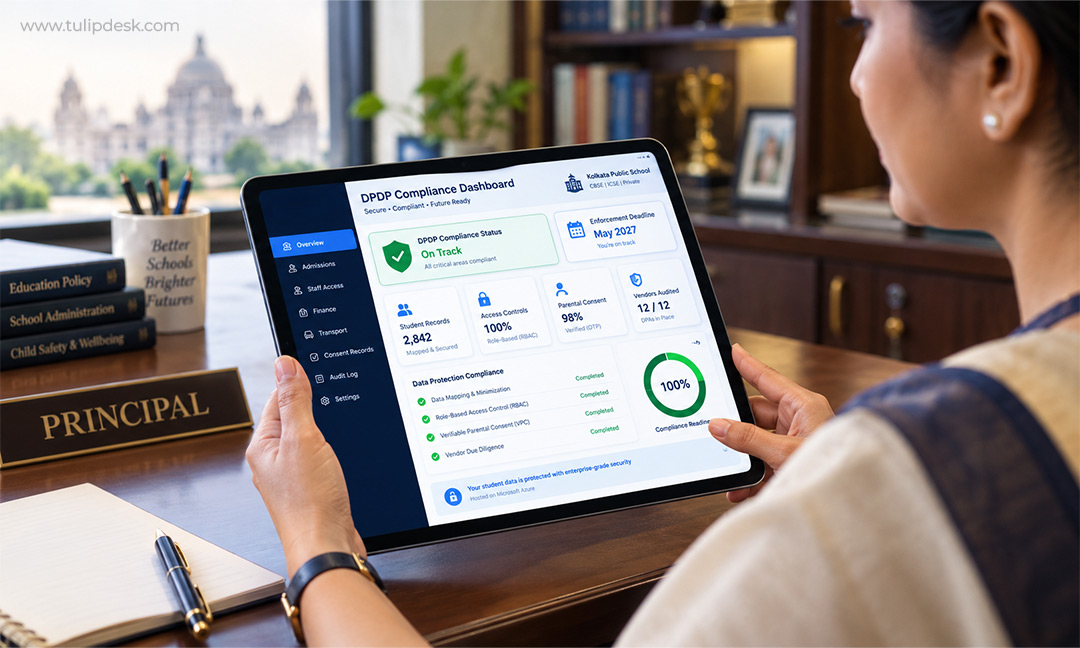
Data Mapping and Minimization:
Locate every location where student data is kept, including cloud files and physical filing cabinets, and remove any unnecessary or redundant information.
Implementing Role-Based Access Control (RBAC):
Do away with flat logins that allow all employees to see everything. Establish stringent operational silos such that medical logs are only accessible to campus nurses, teachers can only view the classrooms they have been given, and accounts personnel may only view fee details.
Verifiable Parental Consent (VPC):
Use digital, OTP-authenticated consent systems that capture a clear timestamp during the admissions process in place of easily misplaced paper diary slips.
Vendor Due Diligence:
Examine all third-party software suppliers, transportation companies, and EdTech apps to make sure they sign strong Data Processing Agreements (DPAs) and never monetize student behavior or track metrics for advertising.
How TulipDesk Simplifies DPDP Compliance
TulipDesk, which is hosted on Microsoft Azure‘s approved cloud infrastructure, is intended to assist Indian educational institutions in fulfilling DPDP Act requirements without increasing administrative burden. Being hosted on a corporate cloud architecture, it transforms daily workflows.
Smart Admissions:
Before any profile is saved, Smart Admissions automatically generates multilingual privacy notifications and obtains verified parent consent using secure OTP tokens.
Strict Staff Portals:
Prevents unwanted data sharing by locking down mass Excel exports and providing fine-grained role-based access control.
Secure Financials:
Provides zero local retention of sensitive card or banking information by integrating directly with reliable payment gateways.
Protected Transport:
During prearranged transit windows, session-authenticated parent portal tracking takes the role of open GPS linkages.
Conclusion
It does not have to be difficult to navigate national data protection rules. Kolkata schools may safeguard student privacy, foster greater parental trust, and confidently navigate statutory audits by reviewing internal spreadsheets, strengthening user access restrictions, and collaborating with an enterprise-grade platform like TulipDesk.