

Why Free School Apps Put Indian K–12 Schools at High Regulatory Risk Under DPDP
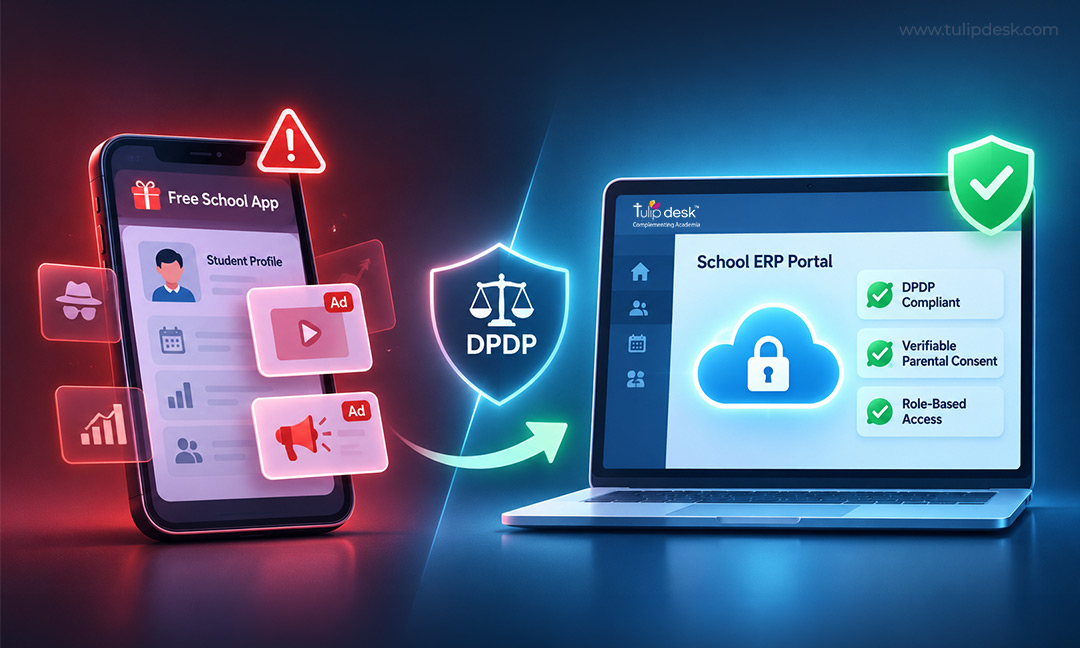
Admissions, money collection, parent communication, and daily attendance are just a few of the many tasks that modern Indian schools must manage simultaneously. Many school administrators use free or inexpensive software tools and apps available online to make things easier. They appear to be an easy way to speed up routine activities without going over budget for the institution.
But you may be unaware of how much that “free” app is actually costing your organization.
With India’s Digital Personal Data Protection (DPDP) Act now actively reshaping how organizations handle information, relying on ad-funded freemium software is a massive regulatory gamble. Let us examine why these informal digital tools put schools at risk of harsh legal repercussions and why secure enterprise software is the only viable option.
The Hidden Trap of Freemium EdTech and Ad-Funded Apps
When software is provided for free or at a low cost, you have to consider how the developers are able to make a living. The business model typically depends on data-driven monetization.
Free school apps, assignment trackers, and communication portals frequently log student activity, monitor user engagement, and sell or share behavioral insights with other networks. When children are involved, this is a clear violation of Indian law, even though it may be typical procedure in commercial consumer apps.
Section 9: The Complete Prohibition of Behavioral Ads and Minor Profiling
The guidelines are very explicit under Section 9 of the DPDP Act. Some practices are definitely forbidden for any organization managing the data of children (anyone under the age of eighteen).
- Monitoring or tracking behavior.
- Launching child-focused advertising efforts.
- Creating profiles of students or making money off of their educational practices and digital traces.
A school, not simply the app creator, is legally responsible if it utilizes a free app that monitors a student’s behaviors. As your school is the Data Fiduciary under the law, you are ultimately in charge of all software that operates on your campus network. You can’t keep track of how long students spend on a page or show advertisements depending on their activity.
Freemium Apps vs. Secure Enterprise SaaS: A Clear Contrast
Architecture, accountability, and security are what separate a casual free software from a suitable enterprise-grade platform.
Data Ownership and Privacy:
Unsecured, multi-tenant public clouds, where student data mixes with commercial data sets, are frequently used by free apps. On the other side, institutional data is isolated within secure domestic infrastructure supported by stringent privacy measures in secure corporate cloud-based school management ERP solutions.
Consent Mechanisms:
Casual checkbox agreements hidden in fine text are typically the foundation of freemium tools. Before any minor data is stored, statutory compliance requires Verifiable Parental Consent (VPC), such as authenticated OTP tokens sent straight to a parent’s registered mobile number.
Internal Access Control:
Anyone with a login is frequently granted broad, flat access to free apps. Teachers only see what they need to see thanks to enterprise solutions’ granular [role-based access control], which totally prevents unwanted data leaks.
Protecting Your School’s Reputation and Financial Health
The Data Protection Board of India has made it clear that there can be hefty financial penalties, up to ₹250 crore for serious data breaches, if sufficient security measures are not put in place. In addition to the penalties, a single data breach exposing student phone numbers, addresses, or report cards has the potential to permanently erode parent confidence and draw harsh scrutiny from school boards.
It takes more than merely checking boxes for an audit to switch from dangerous free tools to a dedicated, ad-free corporate platform. The goal is to establish a secure and reliable digital environment where parents feel comfortable sharing their children’s data.
Conclusion
A deliberate move away from casual, ad-supported freemium apps is necessary to navigate the difficulties of the DPDP Act. Indian schools may eliminate hidden compliance risks and shield their students from behavioral profiling. They can confidently defend their institutional reputation by switching to secure, purpose-built enterprise software like TulipDesk.