

School ERP ROI: Is It Worth the Investment?
Investing in campus technology is now a strategic financial decision for school owners, trustees and educational leaders rather than only a technical one. Educational institutions spend a significant amount of money each year trying to maintain disconnected spreadsheets, loose paper registers, and out-of-date desktop software. However, one important question often comes up when assessing a contemporary school ERP system: Is it really worth the investment? In a nutshell, the answer is yes. Immediate operational efficiency, the elimination of hidden administrative costs, and a strong Return on Investment (ROI) are all achieved by moving from manual or fragmented procedures to a single, cloud-based school ERP system. Let us examine the financial and operational effects of implementing School ERP software in this thorough guide, showing how progressive organizations turn an inevitable operational cost into a valuable asset.
What is a School ERP System?
An educational institution’s entire operational lifecycle can be automated and streamlined with the use of a centralized, cloud-based software platform called a school ERP system (Enterprise Resource Planning). Admission management, fee management, attendance management, examination management, and transport management are all integrated into a single, secure database.
Why Is It Important to Measure School ERP ROI?
School administrators can convince board members and trustees that investing in technology is worthwhile by measuring ROI. Instead of considering software as an ongoing expense, figuring out ROI highlights :
- Staff members save direct labor hours.
- Decrease in paper usage and administrative expenses.
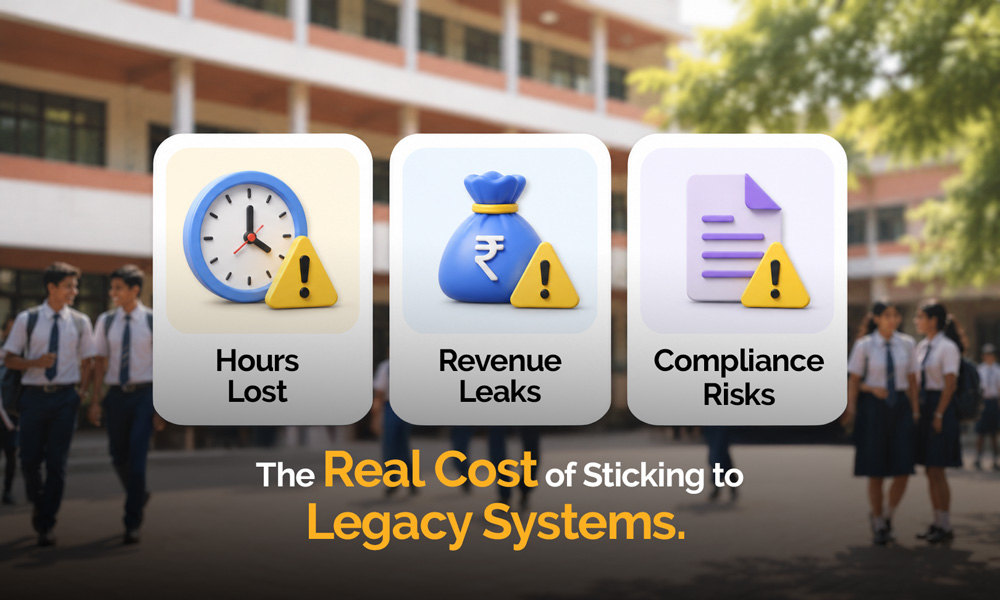
- Elimination of revenue leaks from accounting and fee collection.
- Increased parent involvement, which results in better student retention.
How Does a Cloud School ERP System Drive ROI?
A cloud ERP drives tangible ROI by replacing slow, prone-to-error manual workflows with automated digital processes.
| Traditional Web Hosting | Cloud Platform |
| Web server refers to a server linked to the internet using a public IP. | Many servers are used to host in the cloud platform. |
| Generally, in a web server, it is a fixed server or a single server. | In the cloud, many servers are working on the same platform. |
| The scalability of web servers is negligible as compared to cloud platforms. | The scalability of cloud platforms is significantly high. |
| HTTPS is available at an additional cost. | HTTPS is generally included in cloud platforms. |
| Reliability of typical web servers are very less. | In cloud the reliability is very high |
| Web servers are as good as on-premise servers located at a remote site. | It is well known for a virtual, dynamic, on-demand scalable infrastructure. |
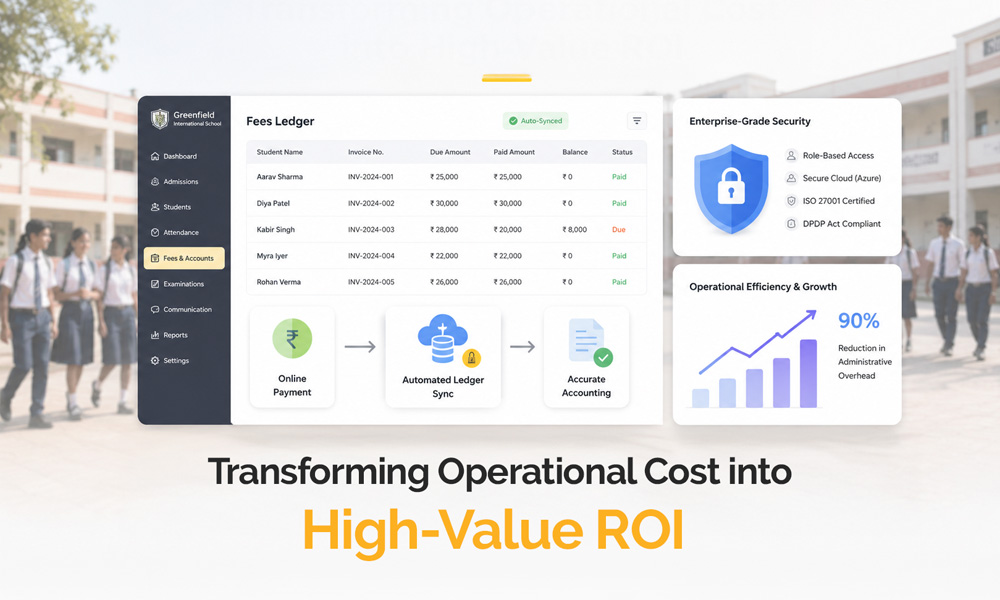
Information no longer becomes trapped in silos as activities switch to a single platform. For instance, when a parent pays tuition via an online portal or Parent Communication channels, the payment is immediately posted to the accounting ledger. No one can discreetly overturn a balance that should not be touched, and no one must reenter it.
Benefits of Investing in a School ERP System
Immediate quantitative and qualitative benefits result from implementing an enterprise-grade platform such as TulipDesk:
Significant Overhead Reduction – Up to 90% less administrative labor is required when gradebook tabulation, admissions, and attendance notifications are handled automatically.
Elimination of Financial Leaks – By preventing manual overrides on past-due fee balances, direct ledger connectivity protects school revenue.
Strong Data Protection – Multi-tier permission trees guarantee complete adherence to India’s Digital Personal Data Protection (DPDP) Act by enforcing Role-Based Permissions.
Improved Academic Governance – Principals can rapidly monitor academic achievement measures using real-time dashboards within the Student Information System.
What Does It Cost to Not Switch?
This is the part schools tend to underestimate. Sticking with the old system isn’t free — it just hides the cost somewhere else.
Teachers sometimes waste 5 to 7 hours every week due to administrative tasks unrelated to teaching. When billing ledgers do not sync correctly, unpaid bills go unreported. Additionally, keeping data in non-compliant methods not only causes difficulty but actually puts a school at risk of regulatory penalties. It is important to note that older desktop programs typically lack audit trails and true data locks, making it possible for illegal access or an inadvertent deletion to go undetected for a very long time. That gap is closed with an appropriate cloud platform.
Getting the Most Out of Your ERP Investment
To achieve the highest return on your school ERP system investment, follow these strategic steps:
- Involve Key Stakeholders Early: Engage department heads, accounting personnel, and teachers during implementation.
- Prioritize Cloud Security: Select software hosted on reliable infrastructure like Microsoft Azure with ISO 27001 and SOC 2/3 certifications.
- Automate Core Revenue Workflows First: Start by digitizing fee collections and admissions to see immediate financial returns.
- Utilize Training & Onboarding Support: Ensure full staff adoption by leveraging vendor support and user guides.

Conclusion:
One of the best ways to modernize campus operations, protect student data, and promote long-term financial stability is to invest in a centralized school ERP system. By automating routine administrative tasks, eliminating financial leaks, and offering real-time academic control, platforms such as TulipDesk ensure that every rupee invested delivers high operational value. If your institution is ready to eliminate administrative drag and unlock real operational efficiency, it is time to upgrade to a future-ready cloud platform.