

How to Build a Strong Parent–School Relationship Through Digital Communication

For years, communication in schools relied heavily on handwritten diaries and paper notices. Teachers dictated homework, exam instructions, and important announcements, while students hurriedly noted them down before the class ended. While this method served its purpose, it was far from reliable.
Students often missed writing homework due to inattention or absence. Notices distributed in classrooms were easily misplaced, damaged, or forgotten in school bags. As a result, important information frequently failed to reach parents, leading to missed deadlines, incomplete assignments, and unnecessary stress for students as well as their parents. With large classrooms and busy schedules, reaching out to each student or parent individually became increasingly difficult in the traditional system of parent-school communication with schools.
Why Parent–School Communication Matters More Than Ever
In today’s connected learning ecosystem, schools in different countries regularly collect important data about students, including attendance, academic performance, and behavior. These indicators are strong predictors of outcomes such as grade repetition and school dropout. However, despite the availability of this valuable information, parents often do not receive these updates in real time.
This communication gap creates a disconnect between parents and schools, limiting opportunities for early intervention and support. When parents remain unaware of attendance issues, declining grades, or behavioral concerns, students may fall behind before corrective actions can be taken.
Independent research and surveys conducted among students across elementary schools in different countries at different times revealed that providing parents with high-frequency updates through school notice and messaging platforms significantly improves student outcomes. Students whose parents receive regular updates showed improved grades, better attendance, fewer behavioral issues, and a lower likelihood of failing the academic year.
These findings highlight a simple but powerful insight: improving and managing parent-school communication systems efficiently through timely digital updates can play a critical role in enhancing student success.
The Communication Gap in Modern Indian Education System
A recent survey by K-12 Techno Services reveals significant awareness of the NEP 2020 and the Right to Education Act, but identifies gaps in communication between parents and schools regarding updates and practices. ~ source TOI
The survey also reveals a clear mismatch between parents’ communication preferences and schools’ current practices. While 74 percent of parents prefer receiving updates on a weekly or monthly basis, nearly 40 percent of schools communicate daily. Additionally, parents strongly favor WhatsApp messages (50 percent) and Parent-Teacher Meetings (28 percent). However, schools primarily rely on Parent-Teacher Meetings (31 percent), parent portals (22 percent), and WhatsApp or SMS (22 percent).
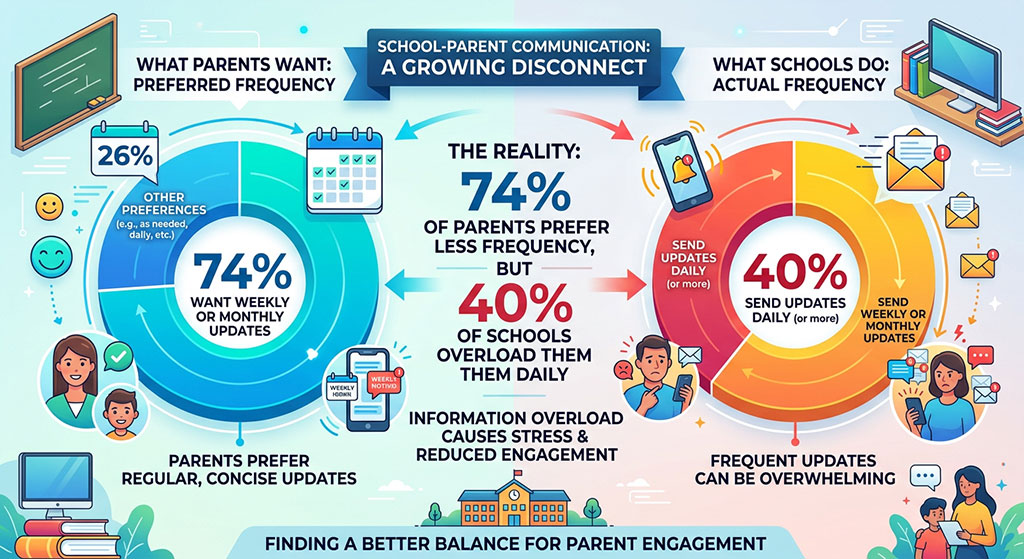
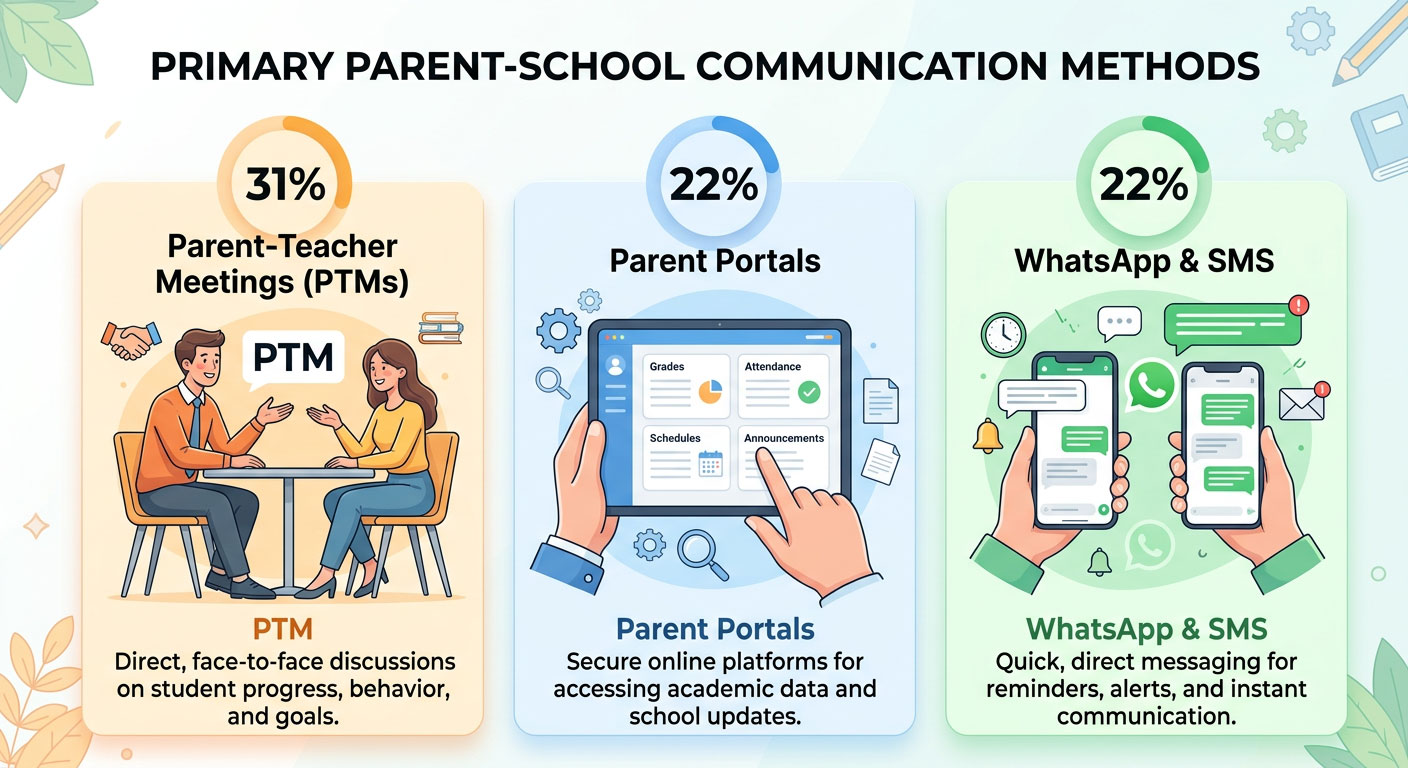
This gap highlights an important opportunity for schools to better align their communication strategies with parental preferences and improve overall engagement, the report noted.
What Is the Problem With This Demand Mismatch?
The mismatch creates three major problems:
- Communication becomes ineffective if schools communicate in ways parents don’t prefer. In that case, messages get ignored, engagement drops and important updates are missed. For example, if schools send daily portal updates but parents prefer weekly WhatsApp summaries, parents may never check the portal.
Result → Communication exists, but engagement doesn’t.
- Information overload versus information gap starts appearing due to too frequent communication (daily updates). It can overwhelm parents. On the other hand, too infrequent communication can leave parents uninformed.
When communication frequency doesn’t match expectations, parents stop paying attention and important alerts lose impact.
Result → Communication fatigue.
- Parent-School Trust gets reduced when communication preferences are ignored. Schools assume parents are uninterested while parents feel disconnected and parent-school collaboration weakens.
Result → Student outcomes suffer.
The Real Problem
While parents often prefer WhatsApp for communication due to its convenience, relying solely on informal communication channels creates several challenges for schools, especially when managing communication at scale.
WhatsApp messages can easily get lost in personal conversations, lack proper documentation, and make it difficult for schools to track whether important updates have been received or acknowledged. Over time, this leads to fragmented communication, inconsistent information delivery, and increased administrative workload.
On the other hand, schools require centralized, structured parent student communication systems to ensure transparency, accountability, and consistency across all stakeholders.
The Shift to Digital Communication in Schools
With the rapid digital transformation in education across India, schools are increasingly adopting School ERP systems to bridge this gap. By centralizing communication and providing real-time updates, ERP platforms help ensure that important information reaches parents and students instantly.
Key Benefits of Strong Parent–School Communication
Better Academic Monitoring
In traditional setups, academic monitoring largely depended on periodic report cards or parent-teacher meetings. A School ERP system changes this by allowing teachers to update assignments, test scores, and classroom performance directly into the system.
Once updated, parents receive instant notifications through the parent portal or mobile app. This continuous flow of information allows parents to track progress regularly rather than waiting for scheduled updates. As a result, academic concerns can be addressed early, and parents remain actively involved in their child’s learning journey.
Early Identification of Learning Difficulties
ERP systems maintain structured records of student performance over time. When teachers update marks, assignment completion, or classroom participation, the system creates a performance trail.
If a student begins to show declining performance or misses assignments frequently, these patterns become visible quickly. Schools can then alert parents proactively, enabling early intervention. This systematic tracking helps both teachers and parents respond to challenges before they escalate into larger academic problems.
Improved Student Discipline and Attendance
Consistent communication regarding attendance and behavior helps create accountability among students. When parents receive timely alerts about absenteeism, late arrivals, or disciplinary concerns, they can address these issues promptly. This collaborative approach encourages better student discipline, reduces absenteeism, and promotes a more structured learning environment.
Increased Parental Engagement
When parents receive regular updates and feel informed, they become more actively involved in their child’s education. Increased parental engagement leads to better academic support at home, improved student motivation, and stronger relationships between schools and families. Engaged parents are also more likely to participate in school activities, meetings, and academic planning discussions.
How Does a School ERP System Enable Real-Time Communication?
Instead of communication depending on manual follow-ups, information moves automatically as part of daily school operations. When attendance is marked, assignments are uploaded, or announcements are created, the system instantly makes this information available to relevant stakeholders without requiring additional effort from teachers or administrators.
Updates are shared at the source
This workflow-driven digital communication for schools ensures that updates are shared at the source. For example, when a teacher records attendance in the system, that data immediately becomes visible to parents. Similarly, when exam schedules, homework, or performance updates are uploaded, they are automatically reflected in parent dashboards or sent as notifications. Communication is no longer a separate task — it becomes a natural outcome of routine academic processes.
Centralized access
Another important aspect of ERP-enabled communication is centralized access. Parents no longer need to depend on students to carry messages or remember instructions. Instead, they can log into a single platform to view attendance records, academic progress, notices, and upcoming events. This centralized approach reduces confusion and ensures that all stakeholders are working with the same information.
Communication consistency
ERP systems also improve communication consistency. In traditional environments, the quality of correspondence may vary from teacher to teacher or class to class. A structured system standardizes how updates are shared, ensuring that every parent receives timely and uniform information. This consistency becomes especially important in larger schools where managing communication manually becomes increasingly difficult.
By embedding communication into everyday school processes, School ERP systems create a seamless, reliable, and real-time communication environment. This not only reduces administrative burden but also strengthens collaboration between parents and schools, ultimately supporting better student outcomes.
How Do Parent Portals and Mobile Apps Strengthen Engagement?
Parent portals and mobile apps are among the most impactful features of modern School ERP systems. They transform communication from occasional updates into continuous engagement by giving parents direct access to school-related information anytime, anywhere. Instead of depending on students to convey messages or waiting for scheduled meetings, parents can stay informed and involved through a centralized digital platform.
For working parents in India, this accessibility is particularly valuable. With mobile-enabled ERP systems, parents can review updates during office breaks, track homework in the evening, or check attendance notifications instantly. This flexibility makes it easier for parents to stay connected to their child’s academic journey without needing to visit the school physically.
Best Practices for Effective Digital Parent Communication
Maintain consistent communication frequency
Establish a predictable communication schedule so parents know when to expect updates without feeling overwhelmed by excessive notifications.
Share meaningful updates instead of excessive notifications
Focus on important academic, attendance, and behavioral updates to ensure communication remains relevant and valuable to parents.
Use structured communication channels
Rely on centralized platforms like School ERP systems to ensure communication is organized, trackable, and accessible to all stakeholders.
Ensure data privacy and security
Adopt secure digital platforms that protect student information and maintain confidentiality while sharing academic and administrative updates.
Encourage two-way communication
Enable parents to respond, ask questions, and share feedback, fostering collaboration and strengthening parent–school relationships.
Conclusion
As Indian schools continue to adapt to a more digitally connected learning environment, traditional communication methods are no longer sufficient to meet the expectations of parents, teachers, and administrators. By reducing communication gaps and streamlining information sharing, ERP systems help foster transparency, accountability, and collaboration. This not only supports better academic monitoring but also strengthens trust between parents and schools.