

The School Fee Leakage Crisis: Why Direct Bank Gateway Integration Beats Third-Party Wallets
For modern educational institutions, digital fee collection is no longer an optional luxury—it’s how school administration actually runs day to day.
And yet, quarter after quarter, plenty of school boards and finance teams are quietly losing revenue to something most people have never heard of: fee leakage.
Here’s the irony. Moving to online payments was supposed to kill the paper trail and clean up the mess. Instead, a lot of schools swapped one problem for another. Generic third-party payment wallets come with their own baggage — hidden charges, slow reconciliation, and gaps in revenue that nobody notices until the numbers don’t add up.
If a school actually wants a financial system it can rely on, the answer isn’t another wallet. It’s cutting out any third party altogether and connecting straight to a bank gateway, built right into the school’s ERP software.
What Fee Leakage Actually Costs You
Fee leakage is more than just unpaid tuition. The little things, like a late settlement here, a missed administrative hour there, or an unaccounted-for cost, are what build up. Typical suspects include:
- Your money is frequently held in third-party wallets for two to five days before it is transferred to the school’s account. That is not a small annoyance; it is actual lost interest and unavoidable cash flow.
- Convenience costs come next. Parents are charged additional fees simply for making payments online, which naturally discourages them from utilizing digital payments at all. Making amends is a headache in and of itself.
- When the wallet’s transaction reports don’t talk to the school’s fee and finance system automatically, someone in accounts ends up manually comparing bank statements against student records, one line at a time. That is hours, often hundreds of hours, wasted on tasks that a computer ought to be performing.
- The traditional failed-transaction issue is another. A parent’s account is debited, but the school’s system displays nothing. Now you have a support ticket, a perplexed parent, and an administrative team working feverishly to resolve money that is in limbo.
The Direct Bank Gateway Advantage: Direct, Instant, and Secure
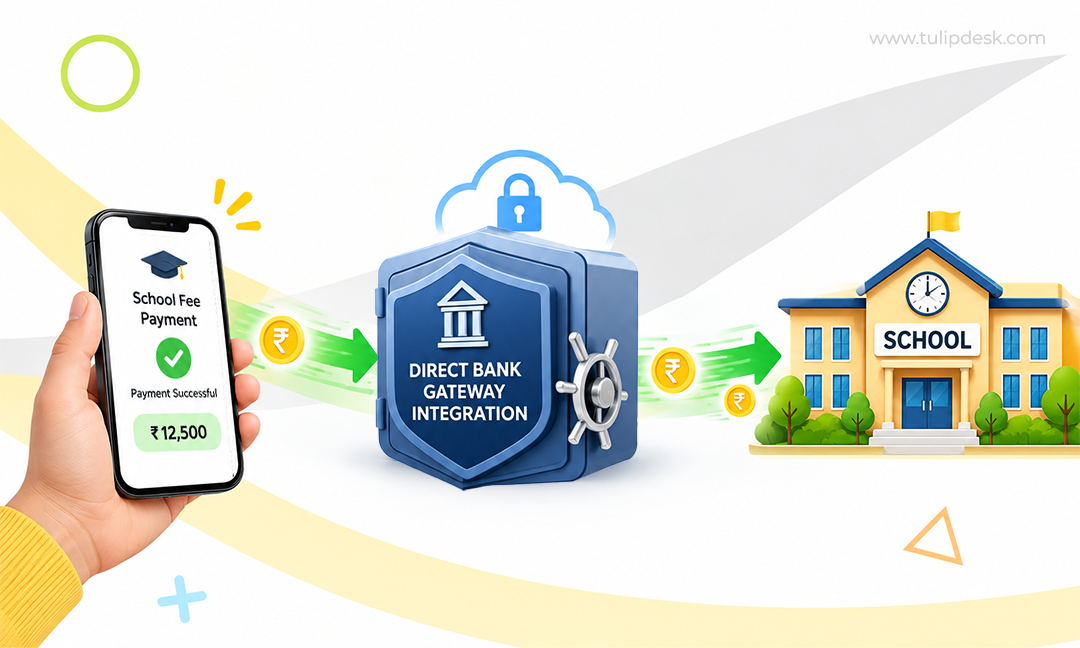
The school’s core ERP is immediately connected to enterprise banking channels through direct bank gateway integration. Without going via outside aggregators, funds move smoothly from the parent’s account directly into the school’s master bank account.
[ Parent / Student ] —> [ Direct Bank Gateway ] —> [ School Bank Account ]
Supported by [ Automated Real-Time ERP Sync ]
Key Operational Benefits:
Instant Credit & Real-Time Liquidity:
Real-time cash flow management is made possible by the removal of multi-day holding periods.
Automated Ledger Reconciliation:
Your [school administration software] immediately synchronizes each incoming payment with the student profile, creating instant receipts and updating balance ledgers.
Zero-Leakage Security & Regulatory Compliance:
By utilizing [enterprise-grade security], such as [Role-Based Access Control (RBAC)], [Multi-Factor Authentication (MFA), and full [DPDP Act compliance], direct integrations based on secure cloud frameworks protect sensitive payment information within national borders.
Reduced Transaction Costs:
Direct banking partnerships guarantee that parents pay precise fee amounts while the school receives full value by drastically reducing intermediary convenience charges.
Using TulipDesk to Simplify Institutional Finance
A cohesive financial ecosystem is necessary to stop financial leakage, not only a straightforward payment link. HK Infoware‘s TulipDesk offers a comprehensive Fees & Financials management solution that connects parent transactions to backend accounting systems and direct banking gateways. Institutions can minimize revenue loss and reduce administrative workload by up to 90%. It needs combining online admission management, fee schedules, dynamic app receipts, and automated bank reconciliation under one secure roof.
Conclusion
Although third-party wallets seem practical, they actually cost schools money, time, and trust through payment friction that parents notice, complicated reconciliation, and delayed settlements. These gaps are permanently closed by switching to direct bank gateway connectivity, which is managed through an appropriate school ERP. This results in quicker settlements, automatic ledgers, and a payment experience that parents will not have to worry about. Selecting a payment method that involves no middlemen at all is the first step in safeguarding a school’s funds.