

How AI is Transforming School Management Systems
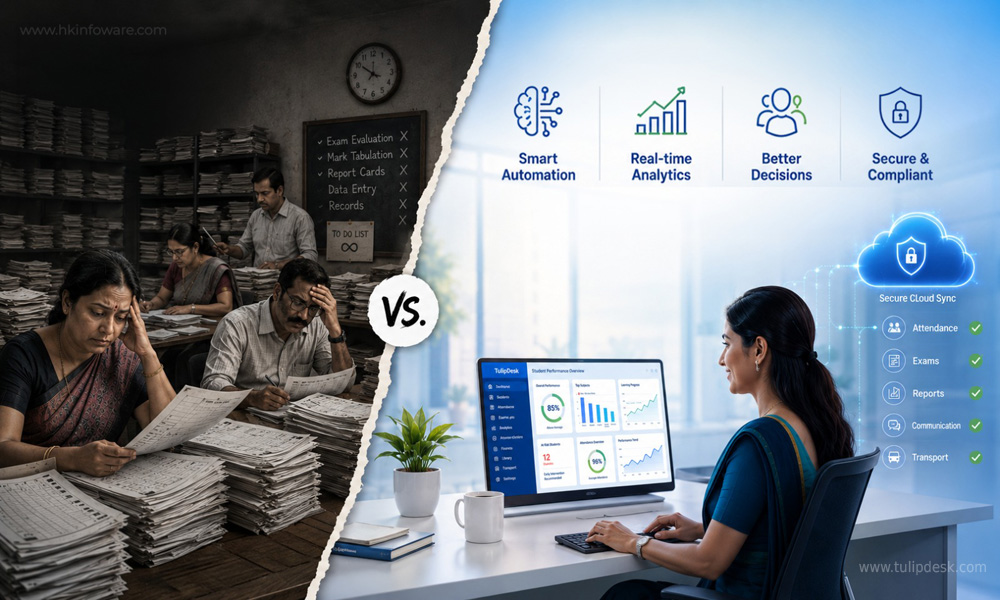
Static spreadsheets, disjointed paper registers, and never-ending manual workflows that somehow took up every hour of the day are all too familiar to us from the past. Everything came to a complete stop as operational demands increased. Mark tabulations took weeks, and teachers ended up drowning in administrative drag. It was draining. Then AI appeared. These days, progressive institutions are implementing artificial intelligence-rich cloud-based school management systems. All that old, reactive chaos is transformed into seamless, proactive, data-driven management by platforms like TulipDesk. Everything is altered by it, and this is how AI is totally changing the rules.
1. Automated Academic Evaluation & Error-Free Tabulation
Do you recall test season?. Teachers would painstakingly review piles of response scripts, record scores on sticky notes, and enter grades into spreadsheets one laborious row at a time until two in the morning. It was a surefire way to experience operational exhaustion.
AI evaluation systems eliminate that. Grades are now processed in minutes rather than weeks. Calculation errors are completely eliminated by automated tabulation, maintaining the integrity of your data. However, the diagnostic insights are more appealing than the quickness. The method records learning trajectories across whole student cohorts to identify specific knowledge gaps rather than producing flat, meaningless report cards. Teachers are able to resume their late evenings. At last, they can concentrate on their true passion: teaching.
2. Spotting Trouble Before It Happens
The AI identifies problematic students weeks before traditional assessments raise red flags by combining cross-departmental data, such as attendance habits, late assignment submissions, and minor score decreases. It is not necessary for counselors to wait for a student to fail. While there is still time to make a difference, they can intervene early and provide focused, individualized help.
3. Master Schedules in Seconds, Not Weeks
If you have ever attempted to create a master calendar free of conflicts for hundreds of students, numerous faculty members, and constrained lab facilities, you are aware that it is a nightmarish problem that typically requires weeks of brainstorming.
Now it is done instantly via smart scheduling algorithms of modern school ERP systems. To prevent burnout, they balance the workloads of teachers. They make the most use of lab and classroom space. They even quickly adjust preferences and resolve elective overlaps. After pressing a button and inhaling, it is finished.
4. Proactive Parent-Student Communication
Good communication holds a school community together, but office staff shouldn’t have to spend all day answering the exact same questions about fees and events.
Chatbots respond to simple parent inquiries around-the-clock and keep them always up to date. In the meantime, parents receive digital report cards as soon as they are ready, real-time attendance updates, and live bus tracking via the Transport Management System via mobile apps. Additionally, messages are immediately translated into preferred native languages of each household, removing obstacles with ease.
5. Reducing Documentation and Securing Information
Not only is paperwork slow, but it also poses a security concern. Sensitive financial logs and student health details are left exposed in outdated configurations with broad, flat user access.
The game is altered by centralized cloud systems like Microsoft Azure that are housed on corporate infrastructure: A 90% reduction in administrative overhead becomes possible as admission, library, and fee collection paperwork just disappears. Direct ledger posting locks billing schedules and prevents illegal overrides, resulting in a 30% decrease in revenue leakage. Every record is protected by multi-tier permission trees, end-to-end encryption, Multi-Factor Authentication (MFA), and complete DPDP Act compliance.
Conclusion:
Transitioning to an AI-powered cloud platform is no longer a futuristic goal. It is just the way that contemporary schools are successful. Your campus works more efficiently, your community has greater faith in you, and your teachers can concentrate on the development of your students when you replace tedious manual tasks with intelligent automation and strong security.
Are you prepared to see how school management systems operate? TulipDesk provides administrative accuracy, predictive analytics, and complete DPDP Act readiness. It is based on enterprise infrastructure developed by HK Infoware Ltd.