

Common Challenges Schools Face Without an ERP Solution
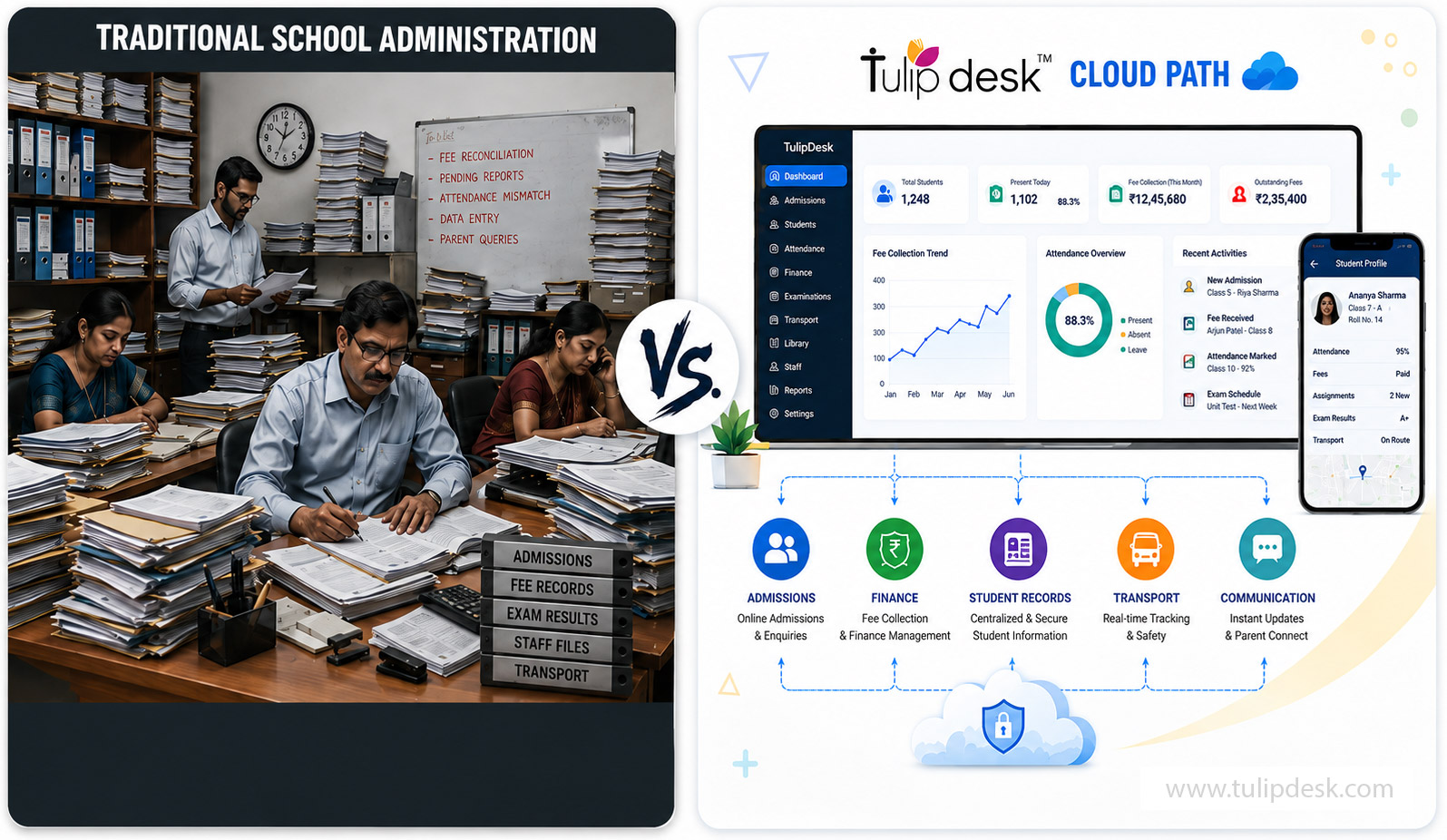
Managing a school requires a lot of juggling. Every day, everything needs to work together, including admissions, attendance, fees, tests, transportation, and communication. Without a school ERP solution, institutions continue to struggle to maintain their juggling act with a lot of manual follow-up, dispersed spreadsheets, and paper registers. It sort of works until it doesn’t. Manual methods have a habit of subtly costing schools more money, staff time, and ultimately trust than anyone realizes. Here’s a closer look at the real issues that arise when a school lacks an effective school administration system.
1. Severe Administrative Overhead and Wasted Productivity
Teachers and office workers wind up performing a startling amount of manual effort on repetitive manual chores in the absence of a school ERP solution. The processing of online admission forms is done manually. Paper logs and attendance are cross-checked. Sheet by sheet, grade books are assembled. One entry at a time, library records are updated. It is gradual and adds up quickly, but it is not particularly difficult.
Paperwork becomes the job:
Employees copy the same data from a register into one spreadsheet, another spreadsheet, and possibly a report for significant portions of their workdays.
Teachers get pulled away from teaching:
Teachers are drawn away from the classroom. Theoretically, the entire goal is lost when an hour is spent on administrative tasks rather than lesson planning or interacting with students.
2. Financial Discrepancies and Revenue Leakage
When fee collection is not centralized, it is one of the simplest areas for things to go unnoticed. Because spreadsheets and paper receipts do not communicate with one another. Without centralized fees & finance management, keeping track of who has been paid, who is in arrears, and the real daily balance becomes a never-ending, error-prone pursuit.
Reconciliation Delays:
Reconciliation becomes a multi-day undertaking. It can take days rather than minutes to compile financial reports from various departments. By the time the data are in, they are already a little outdated.
Departmental Overrides:
No one is keeping an eye out for overrides. Without built-in checks, it is simple for a charge waiver or a manual modification to go unnoticed. This is not always done maliciously; it is only because the system is not detecting it.
3. Data Security and DPDP Act Compliance Risks
With India’s Digital Personal Data Protection (DPDP) Act raising the standard for how institutions manage personal information, data privacy is no longer optional. Spreadsheets are problematic because they are “flat”—everyone who has access to the file often has access to everything in it. Staff payroll, family financial information, and student medical records are all readily available. Most importantly, only one unintentional download away from an issue.
4. Fragmented Communication and Operational Silos
Parents are left in the dark more frequently than they should be when there is no common platform. They are unable to view daily assignment updates and verify attendance in real time or mark the location of the school bus. The outcome is predictable: calls and inquiries that a system might have handled independently flood the front desk. A proper student information system and transport management module naturally take care of all these tasks.
The Bottom Line
None of this is really about technology for its own sake. It has to do with the reality that manual operations subtly create financial risk, compliance vulnerability, and friction, which gets worse the longer it is ignored. At this time, switching to a centralized, cloud-based platform is more of a must for managing a school that’s efficient, secure, and actually manageable.